Norman · grind it or pull it
Stump Grinding vs Removal in Norman, OK
The Norman answer, including when grinding is wrong.
Stump grinding vs removal is a choice between two ways to be rid of a stump. One chews it into chips where it stands; the other digs the whole root mass out of the ground. Stump work arranged here is grinding only, which is exactly why this page can be straight about the second.
What grinding leaves in the yard
Canadian River Tree Service arranges stump grinding, not stump pulling, so when stump grinding vs removal comes up on a Norman quote, the answer is a description of what each method leaves behind rather than a pitch. Grinding leaves a shallow, chip-filled hole where the stump was, the lawn around it undisturbed, and the roots beyond the cut still in the ground. The machine is a toothed wheel on a compact carrier: it comes through a standard gate, sits on boards if the ground is soft, and leaves the way it came. Nothing is dug, nothing is winched, and no truck leaves ruts across the grass to get to the spot.
The chips can stay, raked level, or leave on the trailer. Either way, a few weeks of settling and a bag of topsoil later the spot is seedable, and the roots left behind quietly rot for years without anyone noticing.
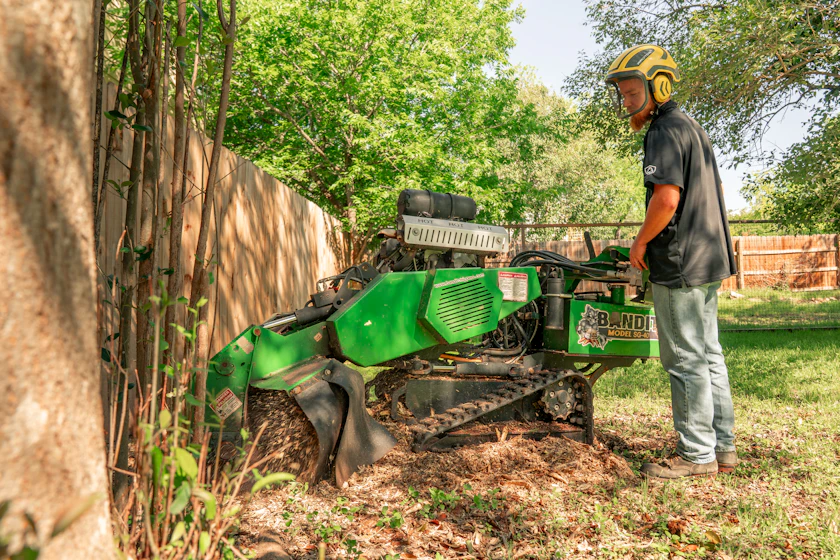
What pulling the stump leaves in the yard
Full stump removal means the root ball comes out of the ground whole: a machine with a bucket, or a winch on a chain, and enough force to break the roots that hold it. What it leaves is a crater the size of the root mass, a pile of roots and dirt that has to go somewhere, and a lawn that has been driven over by something heavy. Irrigation lines and anything else buried near the tree are in the path. The hole needs fill brought in, packed and leveled before it will ever be lawn again. It is real work, done by a different machine than a grinder, and it is the right answer for a narrow set of jobs.
When grinding is the right call
Almost every stump in a Norman yard. A lawn that needs mowing in a straight line again. A bed where a shrub is going in. A fence line that has to be stretched straight over where a hackberry stood — ground low, the new wire runs right across the spot. A stump behind a privacy fence, on a slope, or next to a sprinkler head, where nothing bigger than a grinder could get in without leaving damage. And a tree that is coming down anyway: on removal day the machine is already in the yard, which makes a Norman tree removal with the stump ground the same afternoon the cheapest way there is to get both done.
Replanting is fine after a grind, too — a step or two from the old spot, in ground that is not busy digesting the last tree.
When grinding is the wrong call
A slab, a driveway, a pool, or a footing going exactly where the stump is, with plans that want the root mass gone rather than left to rot under the concrete. Ground that will be excavated for something else anyway. A stump so large, or so wrapped around buried lines, that grinding it would take longer than digging it. Those jobs need an excavation contractor with the machine to match, and the quote should say so instead of grinding a stump that was going to be dug up a month later. Saying so when a job needs something outside the four services is one of the positions held here.
The Norman wrinkle: sprouters, and roots that travel
Cut a Siberian elm, a hackberry, a cottonwood or a Bradford pear off low and it will not accept the decision; the stump throws shoots for years. People sometimes assume that means the stump has to be pulled. Usually not. The shoots grow from the crown tissue at the top of the stump, and a grind deep enough to take that tissue ends the argument for most trees. A few species can still send suckers up from roots well away from the trunk — and pulling the stump does not help with those either, because the far roots stay in the ground whichever method you choose. If your tree is one of them, you will hear it at the quote rather than discover it next June.
The words on both sides of the question
On the grinding side: cutter wheel, the toothed disc; below grade, the depth against the surrounding ground; grindings, the chips-and-soil mix left behind; chase, following a surface root out from the stump. On the pulling side: root ball, the mass of trunk base and major roots that comes out together; spoil, the dirt and root pile that has to be hauled; backfill and compaction, filling the crater and packing it so it does not sink. What a grind costs here, and what moves that number, is on the Norman stump price page.
Grind or pull, answered
Is stump grinding necessary after a tree is cut down?
No, and it is priced as its own line so you can skip it. A stump cut low can sit for years. Grind it when the mower keeps finding it, when sprouts keep coming, or when grass, a fence, or a new planting is going where the tree stood.
Does stump grinding get rid of the roots?
It removes the stump and the crown the sprouts come from, ground out below the surface. The roots beyond that stay in the ground and rot over the following years, which is what most yards want: nothing dug up, nothing to haul, and a spot you can seed.
Do you pull stumps out whole in Norman?
No. Stump work arranged here is grinding. If your project genuinely needs the root mass out of the ground, the quote should say so instead of grinding a stump that was going to be dug up anyway, and the digging is a job for an excavation contractor.
Tell us what the spot is for.
Lawn, bed, fence, or a slab. That one answer usually settles grind or pull, and the quote is free either way.